

Words + interview by Lady Godiva
While MOOF’s Lady Godiva was attending Levitation Festival recently, she had the pleasure of interviewing The Psychotic Monks, a French band who recently put out their third record Pink Colour Surgery. They played day one’s finale, which was one of the most mind expanding sets of the festival.
In this interview, Artie Dussaux (guitar, vocals), Clément Caillierez (drums) and L.G. discussed all kinds of topics, from their early inspirations live to their favorite soundtracks, a safe scene and their long term goals.
MOOF: First, thank you for talking to me. I really like the way you stand out, pushing the boundaries of music and genres. What were the catalysts that explain your evolution, either individually or as a whole band? I know you’ve been very inspired by Francis Bacon and David Cronenberg, who are artists who really provoke reactions. What have you been reading? Watching? Listening to that has kept influencing you?
Artie : Well first, collectively, we founded the group and our m.o (modus operandi) was to learn everything through performing live music. We started in small bars and expanded gradually and it never stopped, until lockdown, which forced us to stop.
MOOF: After that, you did jam sessions.
Artie: Yes, we did. The first thing we did was to take care of ourselves, which was something we hadn’t done in a long time.
MOOF: I think that’s what we gained around that time.
Artie: That was really when we were able to chill, talk and take a step back regarding what was happening at the time in society. It made us change our approach to musical practice a lot. These things had always been there, underlying, especially knowing practice is therapeutic and that’s where we were leaning forward, we dived into that. While changing our approach, we wanted music to be our safe space, for people who could access our live performances or listen to our records. During lockdown, we didn’t even know whether we’d be able to play shows again, so we tried to find our freedom by improvising and letting our jams be all over the place, without setting any limits, which gave us the freedom to add anything to our tracks that we hadn’t done before when we were playing shows regularly and used to keep a kind of structure.
MOOF: Speaking of this, when I watch your live shows, I feel you have out of body experiences, which is very rare. The only band that achieved that before, in my book, was The Birthday Party. I don’t know how you do it but it feels like a transcendental experience.
Artie: Thank you, this is part of the therapeutic aspect I was talking about. It’s a performance practice and that is what is central to us in this project. It’s been a long process. We swiftly had these quite intense phases. Sometimes, I observed myself and didn’t feel I was in my body at all, I was undergoing something but gradually we managed to accompany each other smoothly. We didn’t manage to touch down, so we talked a lot and set some pleasant surroundings and environment, so we really developed the ability to come out of our selves but with much benevolence between us.
Indeed, The Birthday Party was and has always been a very important band to us.

MOOF: Yes, I can see that. Even though you have evolved musically and it is less blatant in the musical content, there are still some real parallels in your performances.
Artie: When we discovered The Birthday Party, what was going on onstage was truly what we were aiming at, not aesthetically but in terms of experiment. Well, having nerded over Nick Cave, he clearly wasn’t doing himself much good.
MOOF: That’s what the critics said, his vocals were expelled through his bowels, that’s how he pushed the boundaries of music.
Artie: We talked about that a lot, within the band.
MOOF: It looked like each show was their last moment alive.
Clément: I think it was pretty much the case, they were at deathstep, given their life.
MOOF: I think your music is really cinematic. Would you like to write a score? And what are your favorite original soundtracks?
Clément: Yes, we would like that. We already did the score to a short film which will be released soon, Artie. It is a French director and the film is about a little vampire girl called Transylvanie. Rodrigue Huart directed it.
MOOF: What are the ultimate film scores to you?
Clément: Taxi Driver.
Artie: And we liked to listen to Under The Skin, a film with Scarlett Johansson. The OST is by Mica Levi. I was also hit by the soundtrack to the first Alien, by Jerry Goldsmith. At that time, people constantly experimented with new technologies. There are lots of very strange instruments, instruments that were made especially, concrete instruments which was quite momentous.
There are so many soundtracks I love… I also love the score to David Lynch’s Lost Highway, which was made by Trent Reznor from Nine Inch Nails. All the soundwork on David Lynch, especially Twin Peaks, the last season where he did the sound effects between music and noise.
MOOF: I saw you recently played with Deadletter, another band that innovates on the boundaries of genres and codes. What other bands do you feel akin to or like playing with?
Clément: I often talk about Amande who opened for us in Tours, she is the singer of Mossai Mossai who does a solo project. It was so stylish, I look forward to seeing her live again. It was so beautiful and soothing, really outstanding. There was also Fishtalk we played with in Caen.
Artie: I love our friends Lambrini Girls.
MOOF: I just watched their set. They’re very cool. Every inch the riot grrrl!
Artie: It is so good to watch them occupy the stage, a space which is primarily owned by men.
MOOF: What I particularly appreciate, besides your music, is your ethical stances and values. I really liked the statement you made on social media, before going on tour about total benevolence. You also reminded people it is individual work in order to be collectively efficient.I wondered what else we can do. I know you collaborate with some non profit and social organizations, like Utopia 56.
Artie: There’s also Consensis that helps us a lot and Act Right who gave us posters and who give us sound advice but like you said, there are so many actors, there’s the crowd, the security staff, the venues, the promoters and like “me too”, the most important thing is to address the problem and raise awareness. This is still a goal because when you mention it, people may go: no way, stop it ! People would rather ignore the problem. People aren’t yet aware that some behaviors are abusive.
MOOF: Of course some behaviors are out of line because they have been inherently enabled and allowed within society for ages. Some things have always been toxic, yet fully considered a norm.
Clément : I think the next step is to give more access to this in terms of education, regarding consent. Some of our relatives work for the board of education and children’s feedback are already complicated before they even are aware of things.
MOOF: Yes indeed that’s a kind of atavism, they copy their ancestors’ patterns and ideas, that’s why things can be so stagnant.
Clément : Capitalism, the root of all evil, we need to extricate ourselves from that first.
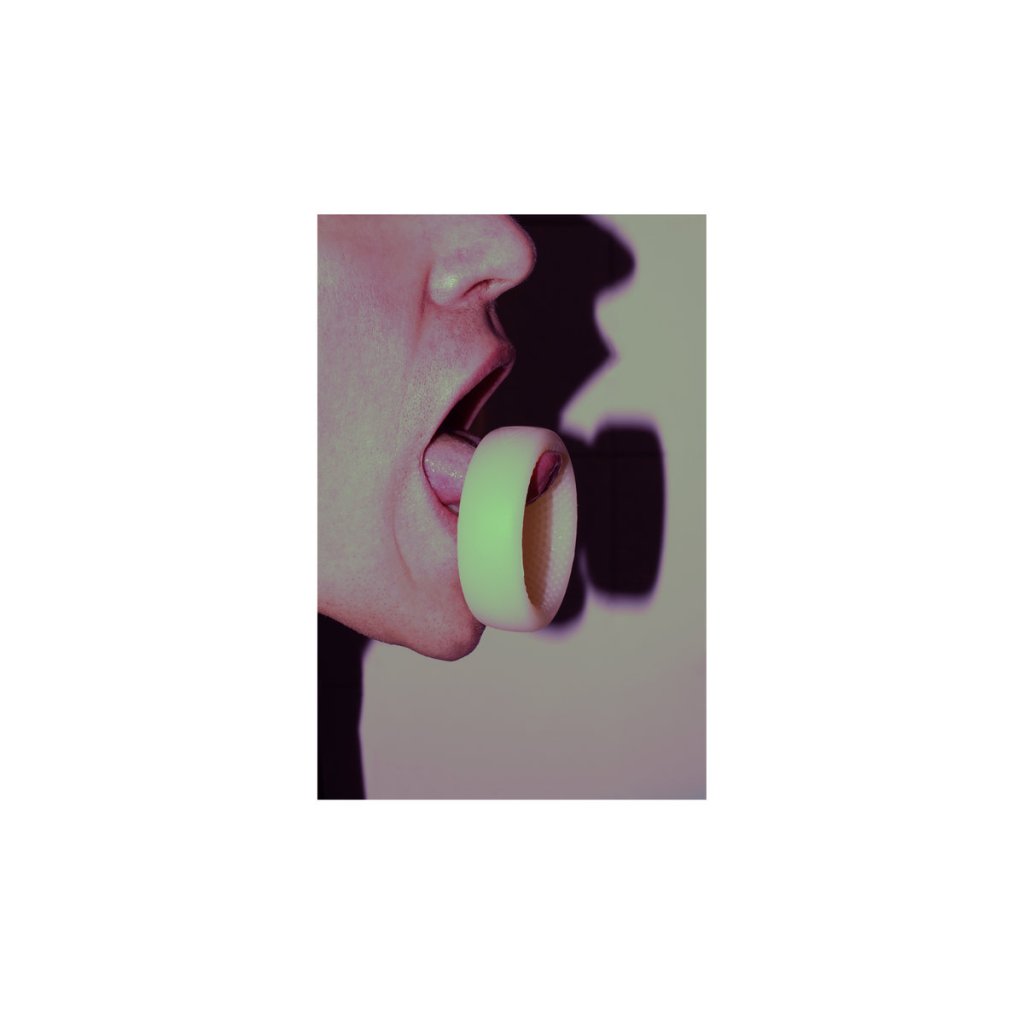
MOOF: For sure! By the way, I was particularly captivated by your latest album sleev which features A contraceptive ring on a man’s tongue, so I asked around who had already used one and some guys were like: “are you kidding?, why would we?” And of course I had to remind women have always been in charge of thaT. Why not make an effort?
Artie: And it’s so much simpler than any birth control for women. Tt’s totally reversible and natural.
Clėment: Some are just too lazy because they don’t want to bother or have been used to not questioning that. There also needs to be more awareness about this to tackle it and get useful info. There is fear and we need to unblock that.
Artie: This is all part of our approach and that’s why we picked that sleeve. One of our main stances is how great self-care is, look after yourself, feel our own bodies physically and remotely respect and care for other people’s bodies. That’s what we aim to pass on and I’m quite hopeful that the next generations will be more mindful of that.
MOOF: And my last question to you, Artie, I was wondering how your transition was received by your audiences. (Artie came out recently as a transgender woman). Have you felt supported? We know trans people are unfortunately very discriminated against and there’s a lot of rampant stigma and prejudice.
Artie: So far I’ve felt quite lucky about how people reacted, I’ve had primarily positive feedback and support. That’s really cool! Of course we live in a society where it’s not easy, day in, day out. At first, I didn’t want to talk about it because I wanted to keep this private but because I’m in the public eye through this band, it was important for me to talk about it and make a public statement, so while touring for the past two months, some trans people have come and talked to me about that. It’s important to be visible, so that trans people know they can be on stage too.
With thanks to The Psychotic Monks for their participation
 MOOF
MOOF 
Leave a comment