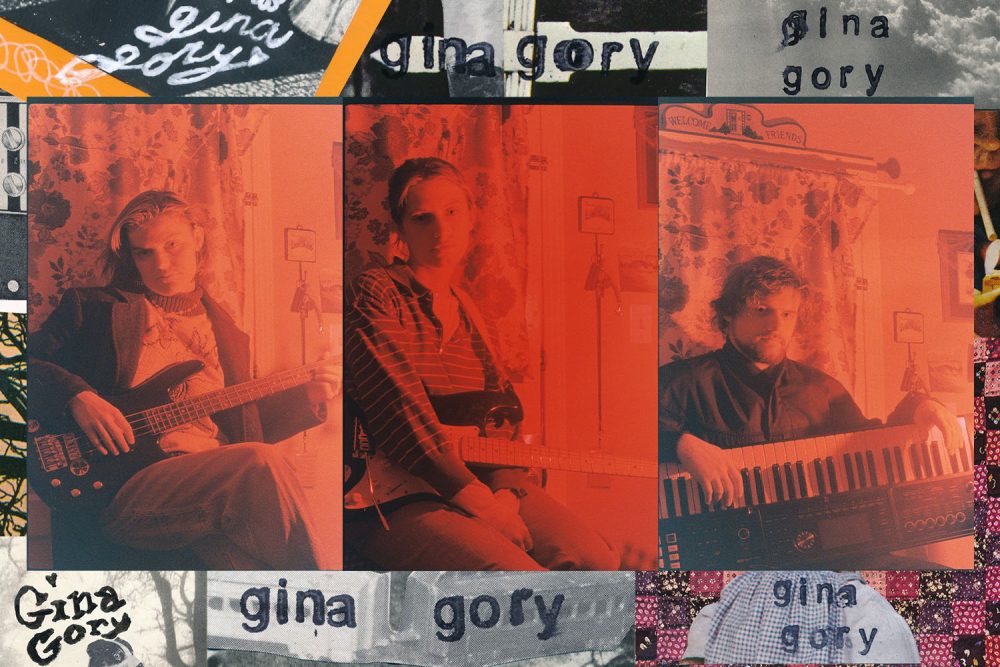


Article cover photo credit: Eric Stevens
Words by Riley Alice
Those who lived their adolescent years online in the early 2000s are perhaps familiar with the Tweet and Reddit thread that quotes “I hope death is like being carried to your bedroom when you were a child and fell asleep on the couch at a family party. I hope you can hear the laughter from the next room.” This melancholy comfort of a death worth living is what Pittsburgh gothpop DIY trio Gina Gory seeks to encapsulate in their debut album Died Laughing, due for release Oct. 11.
It is a rainy Friday morning in early September, and the band has transformed the sidewalk in Pittsburgh into a shared secret circle composed of a damp bench and plastic milk crates. Bassist Connaley Martin is deftly embroidering a blank varsity jacket with a hand-stitched “GG”, an envelope full of band stickers she has made from vintage Sports Illustrated magazines on her lap.
Opposite her is Dylan Henricksen, keyboardist and “drummer”, who takes a folded newspaper article out of his breast pocket to reveal print pictures of guitarist and vocalist Veronika Cloutier and head of Michi Tapes, Eric Stevens. The Pittsburgh Tribune-Review article from just a few months before featured quotes from both of them concerning the revival of physical media in Pittsburgh, which there is something comical about considering Henricksen found the newspaper wrapped around a vase in the Goodwill. The real-life Cloutier is happily sandwiched between her bandmates as the drizzle fades on and off.
The lovable goth-pop project is a manifestation of dark bass chords and poignant lyrics lightened by endearingly kitschy Sprechgesang-style talk-singing and drum-kit samples. With the intention of having the album’s title read in tandem with the band name as an obituary, the band came up with the phrase “Died Laughing”.
“I think scary shit is funny in the context of an old scary movie from the eighties; something cheesy-campy-core instead of Netflix-true-crime-core,” Martin says.
“It’s spooky, but also kind of funny and silly. It doesn’t have to be dark, it could also mean you’re laughing really hard,” Cloutier says. “All of the themes of the album worked out bittersweet that way. Dylan wrote some lyrics, and I wrote some lyrics too, and they all sort of lined up. A lot of the songs I had written about hanging on to something for so long that you can laugh at yourself.” Originally written four steps higher, lead single “If This Love Wasn’t True” was intended to be a love song when Cloutier wrote it in 2020.
“I wrote it while I was in that relationship–which is fucking bizarre–about why would I put up with this person if this love wasn’t true,” Cloutier says, then laughs. “Girl. You didn’t have to put up with that. You shouldn’t have. It’s just about feeding yourself so many excuses, and so much denial until you can’t possibly anymore. To look at it from the lens I have now is very, very strange and very cool, and that’s why I took a spooky route with it.”
Joe Praksti, formerly of rock band Rave Ami, delved further into his unexplored videography element to shoot the music video released with “If This Love Wasn’t True”. Shot all in one day at Pittsburgh’s historical amusement park, Kennywood, the video includes dizzying clips in the funhouse mirrors and Noah’s Ark tunnel–described by Michi Tapes as “Adventureland purgatory”.
“We were supposed to act natural and I couldn’t do it,” Martin says. “My shirt said ‘try not to laugh’ and I just couldn’t do it. I was having so much fun.”
Praksti filmed the video in clips on his grandfather’s handheld 1996 camera and then compiled them into what plays like a found footage reel with an ambiguous nineties aura. “[Praksti’s] grandfather was trying to preserve memories of [his] childhood and family, and now the camera is being used to make a simulation of that with friends,” Henricksen says. “I would be filming all the time as a kid, which is why I even like filming stuff in the first place,” Pratski says. “It was very special to use his camera. There’s some magic there.” Working on a project that he did not have sonic stakes in was a new experience for Pratski, but “so much more fun. Like, impossibly more fun.”
Praksti first became involved with Gina Gory through his former workplace, The Government Center, a Pittsburgh record store and multipurpose venue. Henricksen resided in the apartment above The Government Center upon his arrival to Pittsburgh, and Cloutier worked downstairs in the shop and later managed the branch store, The Outpost. The space became a unifier between not only the three band members, but externally from the band to the community as they played several bills at the venue.

Eric Stevens, head of tape label Michi Tapes, met Gina Gory similarly through his live-manipulation projection gigs at The Government Center and quickly was inspired to photograph them at several shows. The relationship between Stevens and the band blossomed into fruition the summer of 2023 with the release of GG Summer 23’ Demos, a 6-track digital and cassette tape release consisting of 26 hand-collaged J cards.
Similarly to Cloutier’s realization with “If This Love Wasn’t True”, Henricksen used the concept of hidden lace as a recurring motif in his personal writing for years before writing the track “Hidden Lace”, his debut solo lyrical and vocal contribution.
“I was sick when I recorded it, so my voice is a lot deeper,” Henricksen says. “So I think next time we play it live I will have to be ill.”
Sonically, the track is a bombshell, but the lyrics are equally piercing.
“Hidden lace is something that is hidden within everyone. If you pull someone’s strings just right, you can unravel them–it can be spooky or intimate,” Henricksen says. “When I read all the lyrics back, I was like, ‘Oops, this was all about someone that I was dating at the time.’ There’s a dark humor sometimes, and it’s good to laugh it off.”

Other tracks like “Hart of Gold” hover more on the light-hearted side of the album concept, while holding fast to eerie instrumentals. Ex-roommates Cloutier and Martin sing about the tale-as-old-as-time between people sharing a living space about a fridge full of accumulated leftovers and rotten produce, bookended by the wrenchingly honest refrain “Don’t break my heart/ It’s all I’ve got“.
Sadie Shoaf is the visionary behind Sandy Loaf, a Pittsburgh-based multimedia project specializing in handmade prosthetics and sculptures combined with videography. Shoaf welcomed Gina Gory and a small crew into her studio to film the “Hart of Gold” music video. Partially obscured by Shoaf-sculpted masks, Cloutier, Martin, and Stevens filling in for Henricksen sit around a table in a scene reminiscent of a family dinner in a horror movie where something is not quite right.
Daniel Gruschecky, Isabella Schubert, and Shoaf play characters in equally grotesque masks who make out, crawl out from underneath the table, and cringe in the spotlight.
“The masks kind of looked like us,” Martin says, laughing. “They had the same noses.” Every prop, piece of moldy fruit, handmade costume, and mask on set is unique to this music video and will not be seen in any of Shoaf’s future work.
“[Sadie] is really big about not reusing anything that she has made,” Stevens says. “I mentioned it, and she was very firm about it. She was like, let’s do a new thing, and actually do it fast, too. The turnaround time for some of this stuff is crazy.”
The exclusivity and internal networking of the music scene is what makes it attractive at times to outsiders, but also, largely inaccessible. In an era of mass production and consumption, many artists find themselves in not only an external struggle to be seen and heard but an internal struggle to stay true to the ethos of punk.
“I talked to my friend who was in a band in the nineties, and he said he never made a music video because there was no point unless he wanted to sell the cassette to his friends. There was nowhere to share it or broadcast it unless you could get it on TV,” Martin says. “It’s cool that we can make the music videos and people will see them. It’s not about becoming viral or anything, just about doing it and sharing it.
Everybody wants to be heard and successful, but growing up the only example of that is what they see on TV; Hannah Montana and shit like that. That’s what I thought, to be a musician I would have to perform.” Throughout the conception and execution of Died Laughing, Gina Gory has remembered their DIY roots. While you may not be able to get your hands on a unique hand-collaged J-card again like you could with the summer demos, the band is shaping a physical release that promises the attention of fiscal media junkies past Pittsburgh. “If This Love Wasn’t True” will be released on a 7” pressing through Office Boy records in the late fall, and tapes are in the works through Michi Tapes.

Henricksen testifies to the importance of “always being open to experimenting with ways of making things that have lost reliability with time, and trying to reinterpret them to make them fresh again.” There’s irony in the miniature cassette and scrap of newspaper he has stuffed in his pocket, but also truth. He and his bandmates seek to highlight the retired vessels of media and revive them in a haunted but fortified format.
Died Laughing was recorded in its entirety at Trinity Island Studio and mixed by Warren Pryde. “September of 2023, we had that initial recording session with (Pryde). It just felt really good and it was easy,” Henricksen says. None of the band members had recorded in a studio even for personal projects outside of school before.
“He really explained to us his thought process and it was a very educational experience,” Martin says.
“With us not knowing anything about the technical nomenclature of what he was doing, he had to interpret a lot of things that we wanted but didn’t know how to vocalize,” Henricksen said. Pryde also can be spotted as a background character in the music video for “If This Love Wasn’t True”, a sneaky tribute to all of his contributions throughout the Died Laughing vision. All of Gina Gory’s collaborators are treated with this camaraderie, which has fostered a web of creativity and support in their little corner of the Pittsburgh music scene.
It is hard to forget that beyond all of the incredible technical refinements and the art itself, Died Laughing, or as Stevens refers to it, “Gina HD”, is a passion project between three best friends. The humility, creativity, and open hearts that Gina Gory bring to not just Died Laughing but the entire music scene is something that will inspire the upcoming wave of artists in every capacity.

With thanks to Riley Alice and Gina Gory
 MOOF
MOOF 
Leave a comment